Frequently Asked Questions
The most-asked questions about gemstones.
What is this encyclopedia actually about?
It is a community-written reference covering the natural world of gemstones — their geological formation, mineralogical classification, cultural history, and trade significance. The project treats the mineral kingdom as a living lore with its own recurring 'characters,' regional 'factions,' and story arcs stretching back billions of years.
Who are the main 'characters' every newcomer should know first?
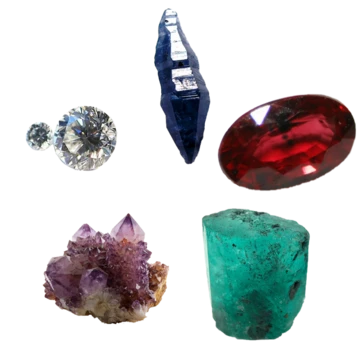
The traditional big four — diamond, ruby, sapphire, and emerald — have anchored jewelry culture for millennia and serve as the baseline against which rarer stones are measured. Most introductory guides and auction catalogs organize their content around these four before branching into the wider roster.
Where should a beginner start reading the lore?
Begin with the Mohs hardness scale and the seven crystal-system families, because every stone's practical behavior — scratch resistance, cleavage, luster — flows directly from those fundamentals. Once that skeleton is in place, layer in color-chemistry origins and famous specimen histories.
What is the 'origin story' behind how gemstones form?
Every gem crystallizes over millions to billions of years under extreme heat, pressure, or hydrothermal fluid flow deep in Earth's crust or upper mantle. Diamond grows from carbon at roughly 150 km depth, while emerald nucleates in narrow alpine veins where beryllium-rich fluids meet iron-bearing host rock.
What separates a true gemstone from an ordinary mineral?
A gemstone is a mineral (or organic material such as amber) that is simultaneously rare, hard enough to polish and retain its finish, and visually striking enough that multiple cultures have prized it across centuries. Of the roughly 5,000 known mineral species, only a few hundred ever satisfy all three criteria and enter the trade.
What are the major 'factions' or stone families?
The broadest split is between silicate-based groups (quartz family, feldspars, tourmaline, topaz) and non-silicate groups (corundum, spinel, diamond, beryl). Within each group, color variants act almost like sub-factions: ruby and sapphire are chemically the same corundum, differentiated only by trace chromium versus iron and titanium.
What is the 'power ranking' system fans always ask about?
The Mohs scale (1–10) ranks scratch resistance, with talc at the bottom and diamond at the top, though the scale is logarithmic rather than linear. For everyday jewelry the practical tier list also weighs toughness, chemical stability, and supply, which is why a 9-hardness corundum outlasts a 7.5-hardness emerald in daily wear.
What are the most 'iconic moments' in gemstone history?
The 1919 cutting of the 112-carat Cullinan diamond into nine major stones remains the single most-watched 'set piece' in the field. The 1886 opening of the Kimberley mine in South Africa is another landmark, because it transformed diamond from a royal curiosity into a global industry within a single generation.
Where are the key 'story settings' — major mining regions?
Frequently cited locations include Myanmar's Mogok Valley (ruby, sapphire), Brazil's Minas Gerais (aquamarine, tourmaline), the Australian outback (opal, diamond), and the Urals (emerald, demantoid garnet). Each region carries its own geological backstory that explains why particular stones cluster there and not elsewhere.
What elevates a single specimen to 'legend' status rather than just a pretty rock?
It is the convergence of extraordinary size, near-flawless clarity, vivid color, and a documented provenance linking the stone to a specific mine, era, or chain of owners. The Hope Diamond, for example, layers nearly four centuries of ownership history over its 45.5-carat blue color, which is why it functions as the field's most recognized cultural icon.