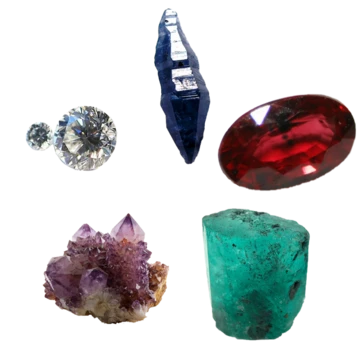
Amethyst
A violet quartz gemstone long believed to prevent drunkenness.

Lodewicus de Honsvels · CC0
Amethyst is a violet variety of natural quartz, a semiprecious stone often used in jewelry. Its name derives from the Koine Greek αμέθυστος (amethystos), meaning 'not intoxicate,' reflecting the ancient belief that it could prevent drunkenness. Amethyst occurs in primary hues from light lavender to deep purple, with secondary red and blue hues, and is found in many locations worldwide, with significant production in Brazil, Uruguay, Zambia, and Canada.
- type
- Mineral (quartz variety)
- chemical_formula
- SiO2 with iron impurities
- hardness
- Same as quartz (7 on Mohs scale)
- color
- Violet, from light lavender to deep purple, with possible red and blue secondary hues
- notable_locations
- Brazil, Uruguay, Zambia, Russia, United States (Arizona, Georgia), Canada (Thunder Bay, Ontario)
- historical_belief
- Prevents intoxication; used by ancient Greeks, medieval soldiers, and Anglican bishops
Lore & Background
Amethyst was used as a gemstone by the ancient Egyptians and was largely employed in antiquity for intaglio engraved gems. The ancient Greeks wore amethyst and carved drinking vessels from it, believing it would prevent intoxication. Medieval European soldiers wore amethyst amulets as protection in battle, in the belief that amethysts heal people and keep them cool-headed. Beads of amethyst were found in Anglo-Saxon graves in England. Anglican bishops wear an episcopal ring often set with an amethyst, an allusion to the description of the Apostles as 'not drunk' at Pentecost in Acts 2:15. The goddess Diana transformed her into a white stone, and Bacchus poured wine over it, dyeing the crystals purple. Variations of the story include Dionysus creating tigers to slay a mortal, who was turned into quartz by Artemis, with Dionysus's tears staining it purple. This myth and its variations are not found in classical sources.
Reader's Guide
Amethyst's significance spans millennia, from ancient Egyptian jewelry to modern gemstone markets. Its violet color, caused by irradiation and iron impurities, makes it a popular semiprecious stone. The belief in its power to prevent intoxication influenced ancient Greek and medieval European practices, and it remains a symbol in Anglican bishop rings. Geographically, amethyst is abundant in Brazil, Uruguay, and Zambia, with notable deposits in the United States and Canada. The ideal grade, 'Deep Siberian,' has a primary purple hue of 75–80% with blue and red secondary hues. Synthetic amethyst, produced via hydrothermal growth, is chemically identical to natural amethyst and can be difficult to differentiate without advanced testing. Treated amethyst, made by irradiating clear quartz, is often sold as citrine or yellow quartz. Amethyst's hardness and resistance to weathering make it suitable for jewelry, though it can fade with overexposure to light and does not fluoresce under UV light.
Did You Know?
- The name 'amethyst' comes from the Koine Greek αμέθυστος, meaning 'not intoxicate,' due to the belief it prevented drunkenness.
- High-quality amethyst, called 'Deep Siberian,' has a primary purple hue of 75–80% with 15–20% blue and red secondary hues.
- The largest amethyst mine in North America is located in Thunder Bay, Ontario, Canada.
- Synthetic amethyst is produced by hydrothermal growth and cannot be differentiated from natural amethyst without advanced gemmological testing.
Ancient Roots & the Name's Meaning
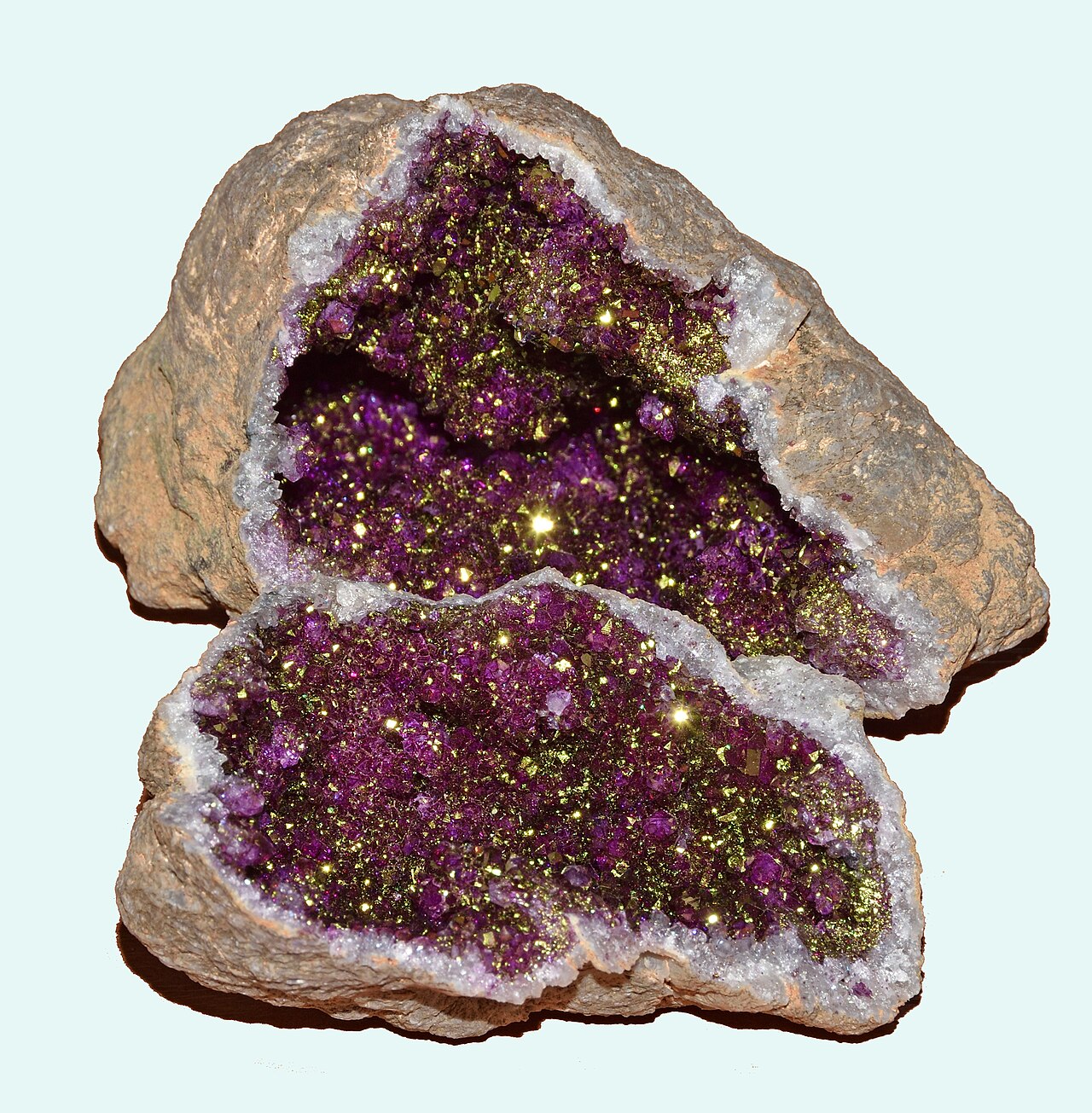
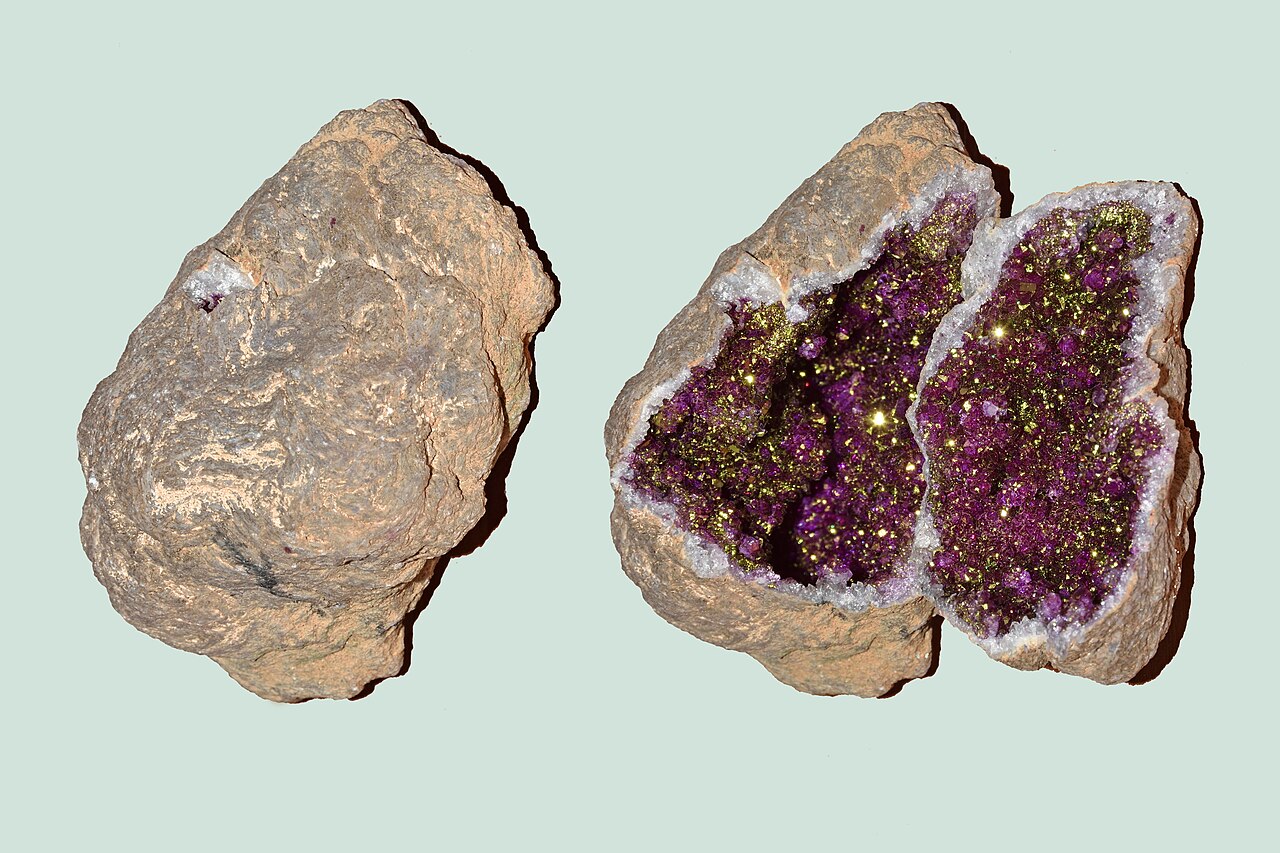
The very name of this violet stone carries a story of sobriety. Derived from the Koine Greek word amethystos, which fuses the prefix meaning "not" with a root meaning "to intoxicate," the mineral was long associated with keeping its wearer clear-headed. Ancient Greeks not only wore amethyst as personal adornment but also carved drinking vessels from it, trusting the stone to ward off the effects of alcohol. That protective reputation carried forward into medieval Europe, where soldiers strapped amethyst amulets to their bodies before battle, believing the gem could both heal wounds and preserve a cool temperament under fire. Beads of the stone have even surfaced in Anglo-Saxon burial sites across England, hinting at its value in early medieval life. In the Christian tradition, the connection to sobriety took on a theological dimension: Anglican bishops traditionally set an amethyst in their episcopal ring, echoing the scriptural description in Acts 2:15 of the Apostles as "not drunk" at Pentecost. The stone's antiquity extends further still, with the Egyptians employing it in intaglio engraved gems, and a spectacular geode from near Santa Cruz, Brazil, drawing crowds at a 1902 exhibition in Düsseldorf.
The Chemistry of Violet
Amethyst is, at its core, a variety of quartz—silicon dioxide arranged in a three-dimensional lattice of tetrahedra, with each silicon atom cradled by four oxygen atoms at the tetrahedron's corners. This rigid architecture is what gives the stone its quartz-level hardness and its notable resistance to weathering, qualities that make it a practical choice for jewelry. The signature violet hue, however, is not inherent to the basic silica structure. It emerges from a complex interplay of irradiation, trace iron in the trivalent Fe3+ state substituting for silicon, and additional transition metals or large-radius trace elements that create intricate lattice substitutions. Under irradiation, those iron ions shed an electron, forming what crystallographers call a [FeO4]0 color center—the actual source of the purple. Natural amethyst is dichroic, displaying both reddish-violet and bluish-violet faces depending on the viewing angle. Heat treatment can shift the color toward yellow-orange or brownish tones, mimicking citrine, though the treated stone loses its dichroism. Prolonged exposure to strong light can fade the violet, while targeted irradiation can deepen it. Notably, the stone shows no fluorescence under either short-wave or long-wave ultraviolet light.
Where the Earth Grows Purple
Amethyst is a remarkably widespread mineral, occurring on every inhabited continent. In Rio Grande do Sul, the gem forms in large geodes embedded within volcanic rock, while hollow agates across southwestern Brazil and Uruguay often conceal a full crop of amethyst crystals lining their interiors. Zambia stands out as one of the world's largest producers, yielding roughly a thousand tons per year. In Russia, particularly near Mursinka in the Sverdlovsk oblast, fine specimens grow in drusy cavities within granitic rock. South Korea, South India historically, and the opencast vein at Maissau in Lower Austria have also contributed to the global supply. In the United States, Four Peaks in Arizona and Jackson's Crossroads in Georgia lead domestic production, with smaller occurrences scattered from Colorado and Texas to Yellowstone National Park and the Lake Superior region. South Carolina has even designated amethyst as its official state gemstone, with several specimens on display at the Smithsonian Museum of Natural History.
From Rough to Ring: Working the Stone
Working amethyst into a finished gem is no simple task. The stone frequently exhibits color zoning, with the deepest violet concentrated at the crystal terminations while the body of the rough may be pale or nearly colorless. In some specimens, only a thin outer layer carries the purple, or the color is so unevenly distributed that a lapidary can salvage just a small fraction of the rough for faceting. The cutter's central challenge is coaxing an even, saturated color into the final product. Quality grading reflects this: the coveted "Deep Siberian" grade demands a primary purple hue of roughly 75 to 80 percent, complemented by 15 to 20 percent blue and, depending on lighting, a touch of red. At the opposite end, "Rose de France" describes a distinctly pale, lavender-to-lilac shade that was once dismissed as undesirable but has gained popularity through modern marketing. Amethyst is typically found in association with calcite, smoky quartz, hematite, pyrite, fluorite, goethite, agate, and chalcedony. For those seeking a lab alternative, synthetic amethyst is grown via hydrothermal synthesis inside a high-pressure autoclave, replicating the natural crystal structure without the geological wait.
Common Misconceptions (Editorial)
- Some people may think amethyst is a synthetic or artificially colored stone, but it is a natural variety of quartz with iron impurities. - A common misconception is that the ancient Greek myth about Amethyst being turned into a white stone and stained purple by wine is found in classical sources, but the facts confirm that this myth and its variations are not found in classical sources. - It is sometimes assumed that amethyst’s ability to prevent intoxication was a purely medieval or modern superstition, but the facts show this belief was held by the ancient Greeks, medieval soldiers, and even referenced by Anglican bishops in relation to Acts 2:15.
Why It Matters (Editorial)
Amethyst endures not only as a beautiful gemstone but as a tangible link to ancient human psychology, revealing how our ancestors sought protection and meaning in the natural world. Its persistent association with sobriety and clear-headedness across millennia—from Greek drinking vessels to modern Anglican rings—shows how deeply we still value symbols of self-control and spiritual clarity.
Gallery
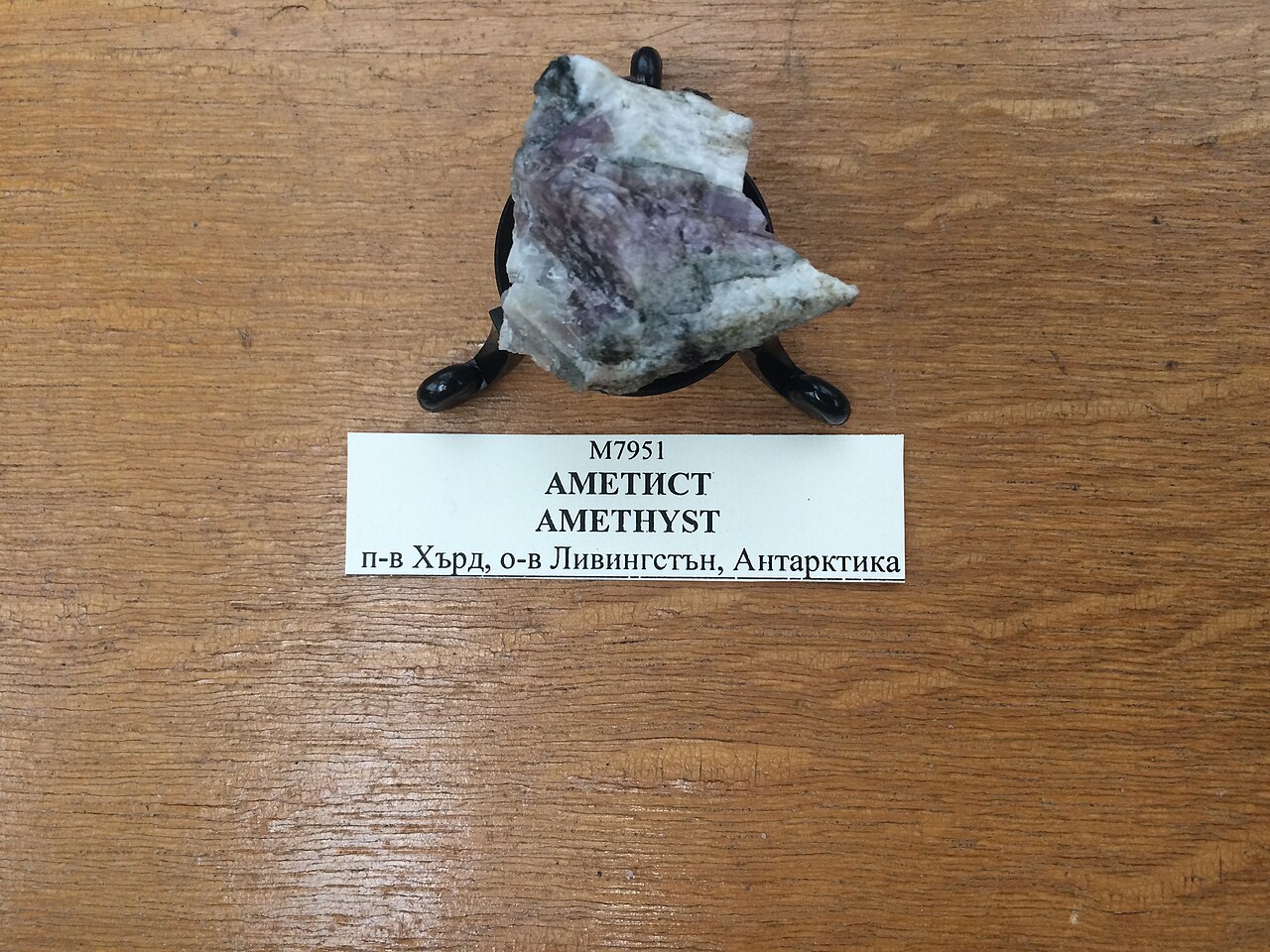

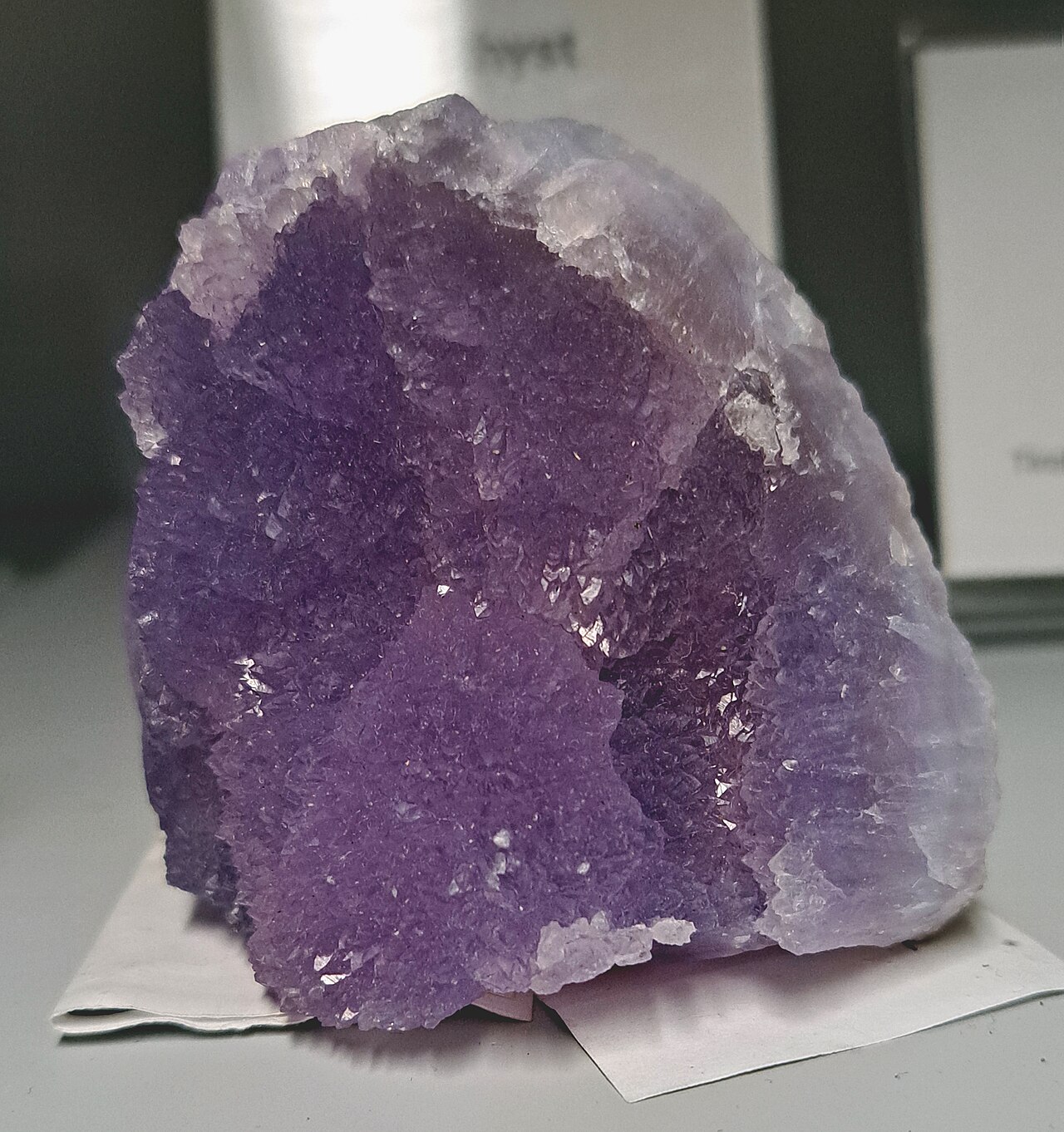
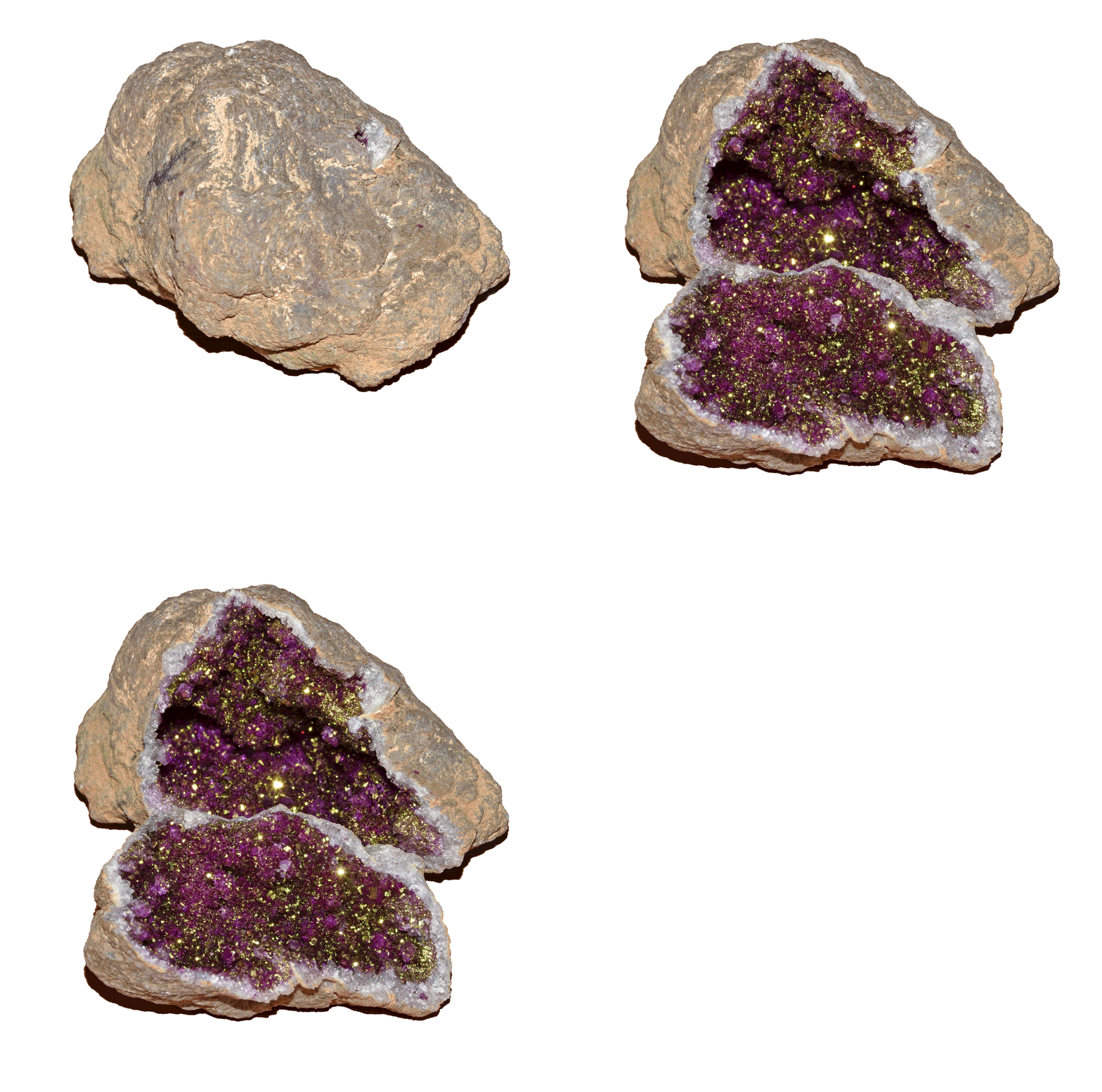
More in Gemstones 1-22
Spotted an error? Know more?
This is a living reference — every entry is fact-audited, and reader corrections feed straight into our audit queue. Suggest an edit · See this site's audit record