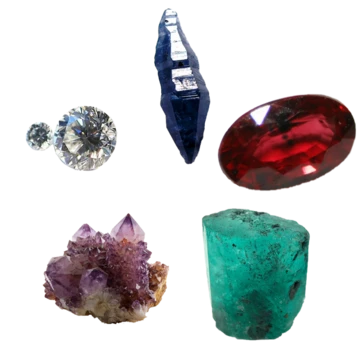
Jade
Jade is a decorative rock used for ornaments and ritual objects.

Jade is an umbrella term for two different types of decorative rocks used for jewelry or ornaments: nephrite (a silicate of calcium and magnesium in the amphibole group) and jadeite (a silicate of sodium and aluminum in the pyroxene group). It is well known for its ornamental use in East Asian, South Asian, and Southeast Asian art, as well as in Latin America, particularly Mexico and Guatemala. The use of jade in Mesoamerica for symbolic and ideological ritual was influenced by its rarity and value among pre-Columbian cultures such as the Olmecs, the Maya, and other ancient civilizations of the Valley of Mexico.
- type
- Decorative rock (nephrite and jadeite)
- primary colors
- Nephrite: green, yellow, white, black; Jadeite: white, near-colorless, green (including imperial), lavender, yellow, orange, brown, black, rarely blue
- classification
- Type A (natural, untreated), Type B (resin-enhanced), Type C (colorant-enhanced)
- major historical sources
- China (Ningshao, Liaoning, Inner Mongolia, Khotan, Lantian), Myanmar (Kachin State)
- etymology
- From Spanish 'piedra de ijada' (flank stone), via Latin 'ilia'
- national gemstone of
- Japan
Lore & Background
Jade is classified into three main types: Type A (natural, untreated jadeite jade), Type B (resin-enhanced), and Type C (colorant-enhanced). Type A is the most valuable, prized for its purity and vibrant colors, and is revered for its symbolism of purity, harmony, and protection in various cultures, especially in East Asia. The English word 'jade' is derived from the Spanish term 'piedra de ijada' (flank stone), from its reputed efficacy in curing ailments of the loins and kidneys. Nephrite is derived from 'lapis nephriticus', a Latin translation of the Spanish term.
Reader's Guide
Jade has held significant cultural and spiritual importance across multiple civilizations. In China, jade was considered the 'imperial gem' and used for utilitarian and ceremonial objects, from indoor decorative items to jade burial suits. The finest white jade from Khotan was sent as tribute to the Chinese Imperial court and worked into objets d'art, having a status-value exceeding that of gold or silver. In Japan, jade is the national gemstone and has been used since the early Jomon period, with all ancient jade coming from Itoigawa. In Korea, jade was used in comma-shaped ornaments found on gold crowns of Silla royalty. The Salar Jung Museum in Hyderabad, India, holds a wide range of jade hilted daggers. Today, Myanmar is estimated to be the origin of upwards of 70% of the world's supply of high-quality jadeite.
Did You Know?
- In China, jadeite is traditionally called 'fei cui', a name used long before the term 'jadeite' was created in 1863.
- The Jain temple of Kolanpak in Telangana, India, houses a 5-foot-high sculpture of Mahavira carved entirely out of jade.
- The Chinese character 玉 (yù) is used for several types of stone known in English as 'jade', including jadeite and nephrite.
Common Misconceptions (Editorial)
1. Some people think "jade" refers to a single mineral, but it is actually an umbrella term for two different types of decorative rocks: nephrite and jadeite.
2. A common misconception is that jade only comes from East Asia, but it has been historically significant in Latin America, especially in Mexico and Guatemala, among pre-Columbian cultures like the Olmecs and Maya.
3. Not all jade is created equal — many assume all green jade is valuable, but jade is classified into Type A (natural, untreated), Type B (resin-enhanced), and Type C (colorant-enhanced), with Type A being the most valuable.
Why It Matters (Editorial)
Jade endures not merely as a decorative stone but as a cultural touchstone that has bridged ancient civilizations across continents, from East Asian ritual objects to Mesoamerican symbolic regalia. Its lasting value lies in how it embodies ideals of purity, harmony, and protection, while also reflecting human artistry and trade networks that have persisted for millennia.
More in Gemstones 1-22
Spotted an error? Know more?
This is a living reference — every entry is fact-audited, and reader corrections feed straight into our audit queue. Suggest an edit · See this site's audit record