Emerald
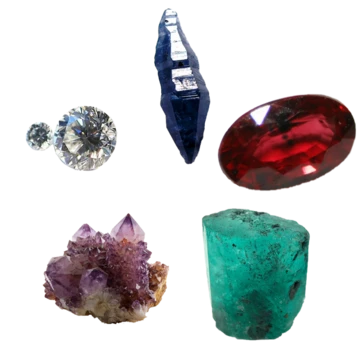
Green beryl gemstone, one of the four precious gems.

Charles J. Sharp · CC BY-SA 4.0
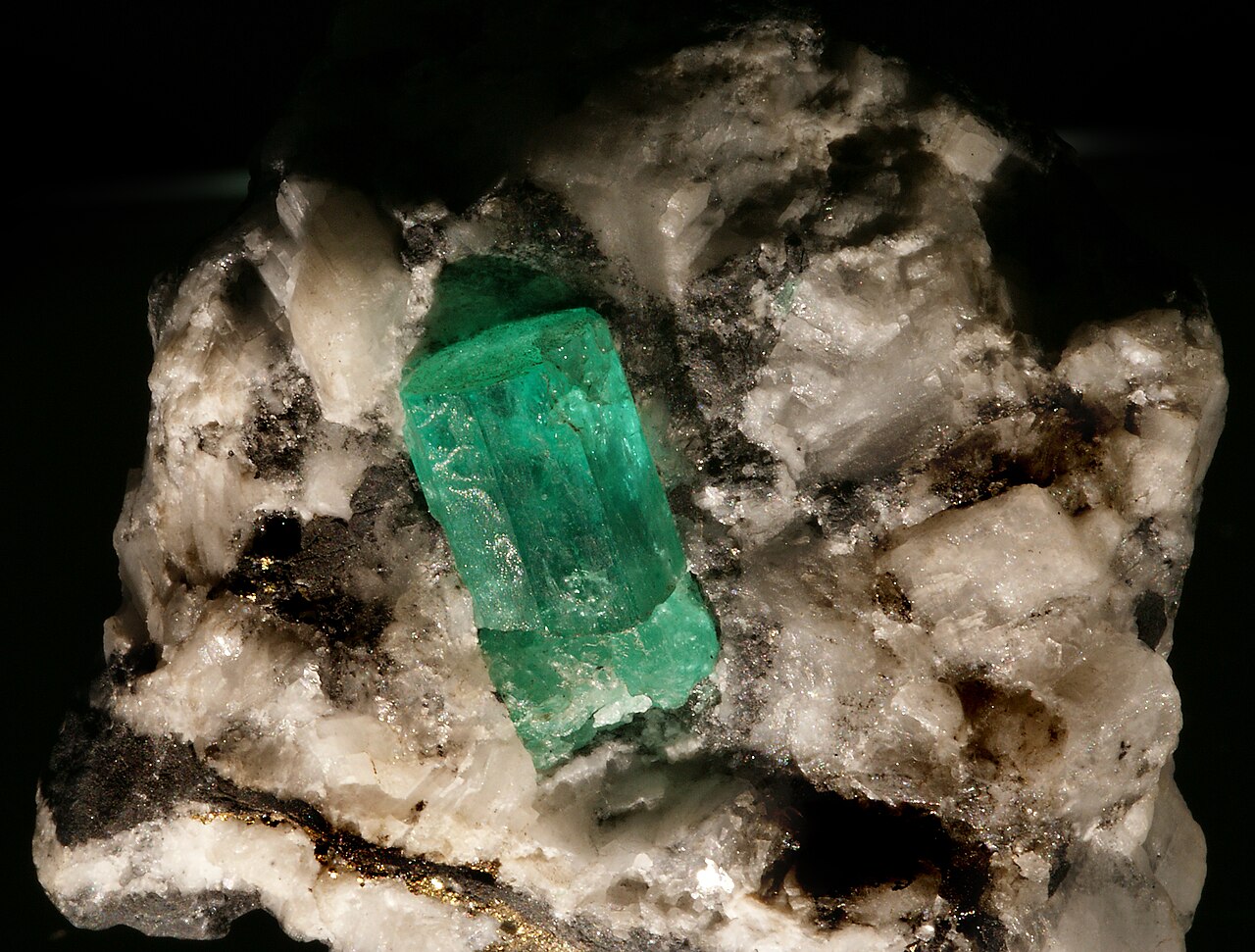
Emerald is a gemstone and a variety of the mineral beryl (Be3Al2(SiO3)6), colored green by trace amounts of chromium or sometimes vanadium. It ranks among the traditional 'big four' precious gems along with diamonds, rubies, and sapphires. Emeralds have a hardness of 7.5–8 on the Mohs scale but are classified as having poor toughness due to numerous inclusions. They typically occur in association with other beryls, feldspars, micas, and quartz, though specific mineral associations vary widely by deposit.
- field
- Gemology
- known_for
- Green variety of beryl, one of the four precious gemstones
- hardness
- 7.5–8 on Mohs scale
- color_cause
- Trace amounts of chromium or vanadium
- major_producers
- Colombia (historically largest), Zambia (second biggest)
Lore & Background
Emeralds are graded using the four Cs: color, clarity, cut, and carat weight, with color being the most important. They occur in hues from yellow-green to blue-green, with the primary hue being green. Only gems of medium to dark tone are considered emeralds; lighter ones are called green beryl. Most emeralds have numerous inclusions and surface-breaking fissures, and are graded by eye rather than under magnification. Stones lacking visible inclusions are considered flawless.
Reader's Guide
Mining in Egypt ceased with the discovery of Colombian deposits. Zambian emeralds tend to be bluish green to green with superior transparency and fewer inclusions than Colombian varieties. Emeralds are found worldwide, including in Afghanistan, Australia, Brazil, Canada, China, Ethiopia, India, Madagascar, Mozambique, Pakistan, Russia, the United States, and Zimbabwe. In the US, they have been found in Connecticut, Montana, Nevada, North Carolina, and South Carolina. Research using energy-dispersive X-ray spectroscopy has shown that trace chemical element differences can distinguish emeralds from different mining locations, even those in close proximity. Synthetic emeralds have been produced via hydrothermal and flux-growth methods, with the first commercially successful process by Carroll Chatham, likely using a lithium vanadate flux.
Did You Know?
- Emerald is a variety of the mineral beryl, colored green by trace amounts of chromium or sometimes vanadium.
- Most emeralds are oiled after cutting to fill surface-reaching cracks, with cedar oil commonly used.
- Colombia has historically been the world's largest producer of emeralds, though exact production figures vary by source.
- The word 'emerald' derives from Ancient Greek 'σμάραγδος' (smáragdos), meaning 'green gem'.
Classification & Identity
Emerald holds a distinguished place in the taxonomy of gemstones as the green variety of the mineral species beryl. Just as ruby represents the red expression of corundum while all other corundum colors fall under sapphire, emerald occupies the green slot within a family that also includes blue aquamarine, red beryl, colorless goshenite, yellow heliodor, and pink morganite. This species-and-variety framework is part of a broader classification system that organizes gems into groups, species, and varieties. Emerald's status as one of only four "precious" stones—alongside ruby, sapphire, and diamond—stems from a tradition stretching back to the ancient Greeks. The designation reflects both the historical rarity of these minerals and their shared physical qualities: translucency, fine color in their purest form, and exceptional hardness scoring between 8 and 10 on the Mohs scale. Yet this ancient hierarchy does not always align with modern market realities. A green garnet known as tsavorite, for instance, can command a price far exceeding that of a mid-quality emerald, reminding us that the precious label speaks more to heritage than to a fixed hierarchy of worth.
Grading & the Art of Evaluation
Unlike diamonds, which benefit from the standardized GIA grading system introduced in the early 1950s, emeralds and other colored gemstones lack a universally accepted evaluation framework. In practice, gemologists assess emeralds using the naked eye, assuming 20/20 vision, rather than the 10x magnification that became standard for diamond clarity grading. The familiar "four Cs"—color, cut, clarity, and carats—serve as a useful mnemonic, but their relative importance shifts dramatically when applied to a colored stone. For emerald, the purity and beauty of its green hue takes precedence above all other factors. Clarity, meanwhile, is understood with a degree of grace: emeralds will invariably contain inclusions, and their presence is expected rather than penalized. The concept of "water" offers another layer of assessment, with very transparent stones earning the designation "first water" while those of lesser transparency fall into second or third water categories. Unusual optical phenomena such as color zoning or asteria can further distinguish a specimen, and the stone's luster, refractive index, and dispersion all contribute to the final judgment rendered by a trained gemologist.
Market Context & the Shifting Meaning of 'Precious'
The global colored gemstone industry—encompassing everything from emerald to opal—was valued at approximately 1.55 billion US dollars as of 2023, with projections pointing toward 4.46 billion by 2033. Emerald sits at the heart of this expanding market, yet the very word "precious" that has adorned it for millennia is increasingly seen as a commercial misnomer. The traditional four-stone hierarchy (emerald, ruby, sapphire, diamond) was rooted in ancient scarcity, but modern commerce has blurred those lines considerably. Amethyst, once ranked among the cardinal gems since ancient Greece, lost its precious status after bulk deposits were discovered in Brazil during the 19th century. Similarly, aquamarine, peridot, and cat's eye (cymophane) have at various points been elevated to precious standing based on popularity. Today, the gemstone trade largely abandons the precious-versus-semi-precious divide, with many stones finding their way into even the most expensive jewelry. The lesson for emerald is that its enduring prestige rests less on a fixed taxonomic rank and more on the sustained desirability that color, rarity, and cultural memory continue to bestow.
Physical & Optical Identity
At the most fundamental level, a gemologist identifies emerald first through its chemical composition, then through its crystal system—gems are classified as cubic, trigonal, monoclinic, and so on—and the characteristic habit, or natural form, in which the crystal is typically found. Beyond these structural identifiers, emerald is described through a rich vocabulary of optical and physical properties: hue, tone, and saturation define its color; luster, refractive index, birefringence, and dispersion describe how it interacts with light. Emeralds, like many gems, may exhibit pleochroism or double refraction, and some display luminescence or a distinctive absorption spectrum. Their hardness, cleavage, and fracture patterns further distinguish them from other minerals. Inclusions—natural material or flaws trapped within the stone—are a defining feature of emerald, and their character and distribution become part of the stone's individual identity. The interplay of all these properties, from the deep green saturation to the subtle internal inclusions, is what separates one emerald from another and elevates the finest specimens to the pinnacle of the precious stone tradition.
Common Misconceptions (Editorial)
Some people think emeralds are extremely hard and durable like diamonds, but while they have a hardness of 7.5–8, they actually have poor toughness due to numerous inclusions. Another misconception is that all green beryl can be called emerald; in fact, only gems of medium to dark tone qualify, while lighter ones are classified as green beryl. It is also often believed that flawless emeralds are common, but most emeralds have visible inclusions, and stones lacking any are considered exceptionally rare and flawless.
Why It Matters (Editorial)
Emerald endures as one of humanity’s most treasured gems, ranking alongside diamonds, rubies, and sapphires for millennia. Its rich green color—caused by trace elements like chromium—has symbolized wealth, royalty, and rebirth across cultures, from ancient Greece to modern jewelry markets. More than a decorative stone, emerald connects us to geological processes deep within the Earth, making it a lasting fascination for both science and art.
Gallery



More in Gemstones 1-22
Spotted an error? Know more?
This is a living reference — every entry is fact-audited, and reader corrections feed straight into our audit queue. Suggest an edit · See this site's audit record