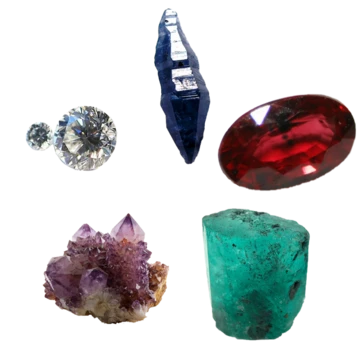
Opal
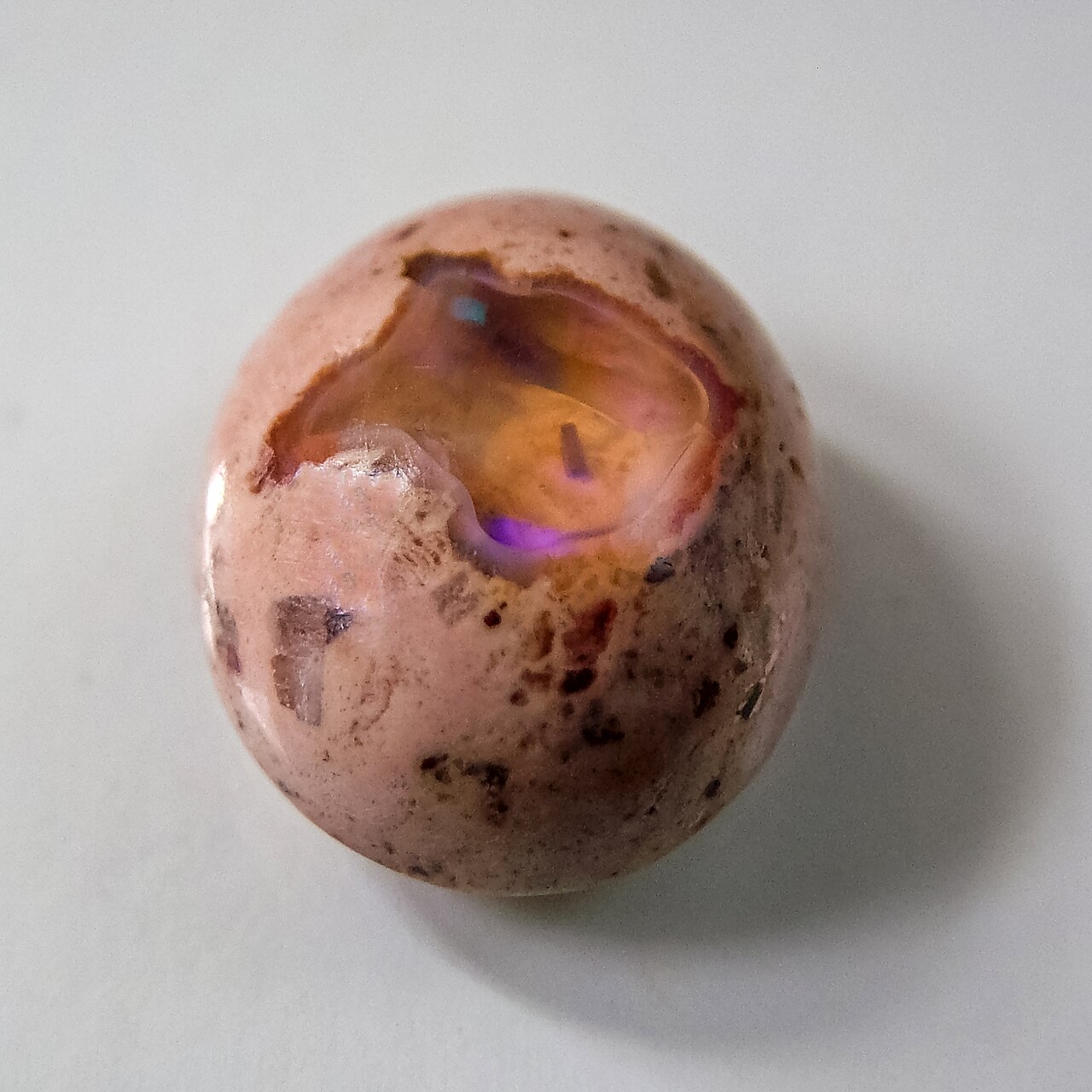
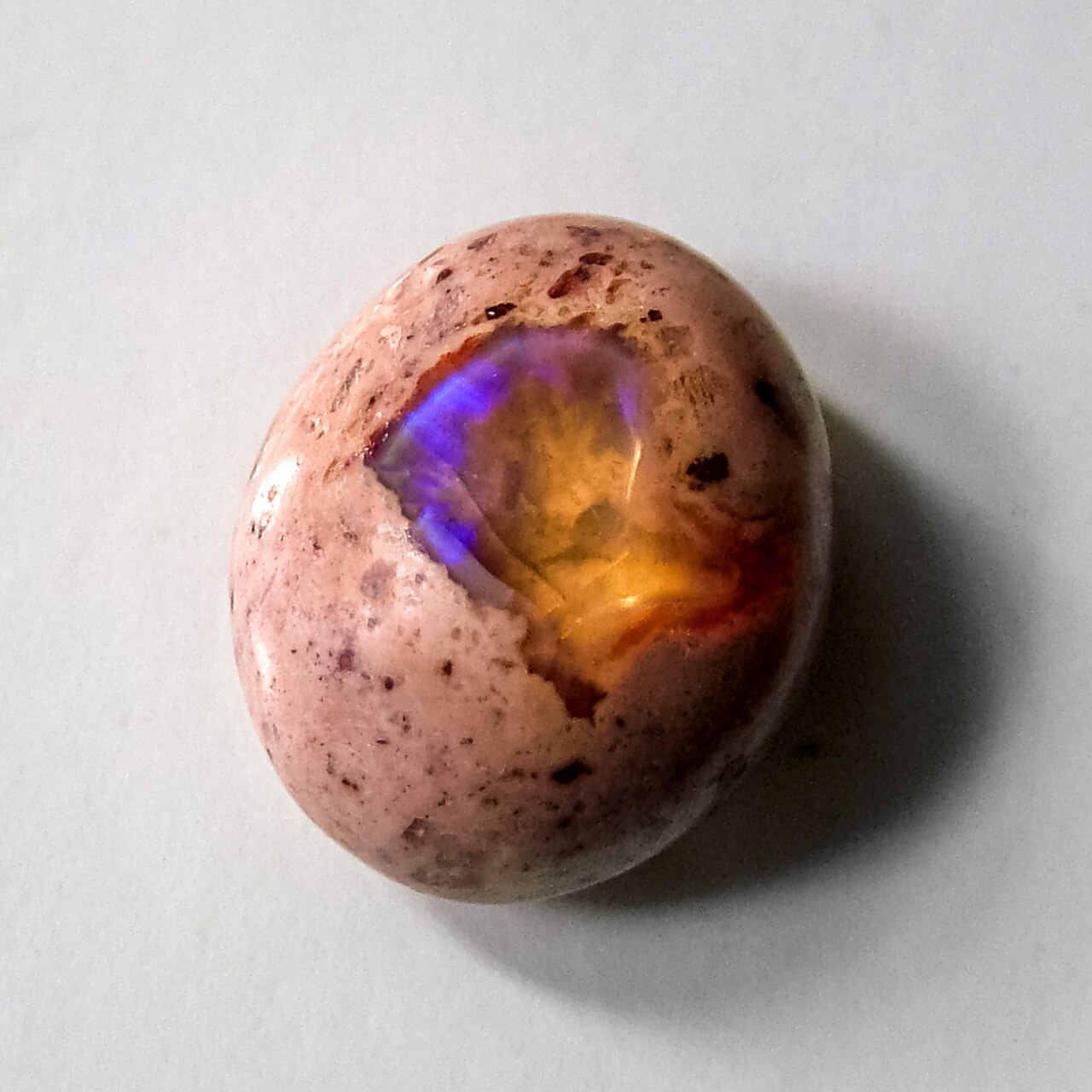
A mineraloid gem known for its play-of-color and amorphous silica structure.

Lambtron · CC BY-SA 4.0
Opal is a hydrated amorphous form of silica (SiO2·nH2O) with a water content usually between 6% and 10% by weight, though extreme cases can range from 3% to 21%. Due to its amorphous structure, it is classified as a mineraloid, unlike crystalline forms of silica. Opal is deposited at relatively low temperatures and occurs in fissures of many rock types, most commonly with limonite, sandstone, rhyolite, marl, and basalt. The name is believed to derive from the Sanskrit word 'upala' (jewel) and later the Greek 'opállios'. There are two broad classes: precious opal, which displays play-of-color (iridescence), and common opal, which does not.
- water_content_range
- 3% to 21% by weight (usually 6% to 10%; the broader range includes extreme cases and is not standard for precious opal)
Lore & Background
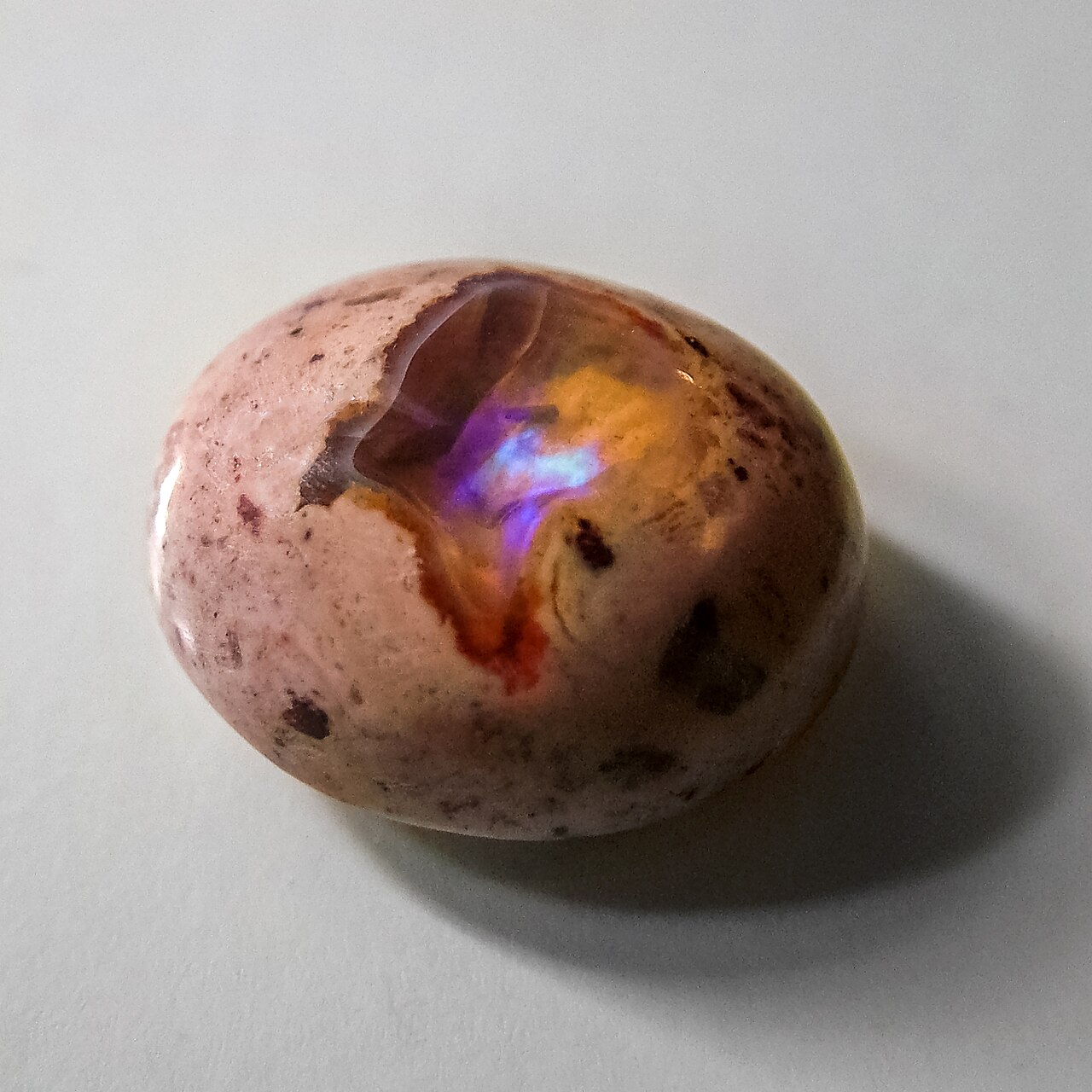
In the mid-1960s, J. V. Sanders proposed that ordered spheres produce colors by interference and diffraction of light, a mechanism later more fully described using Bragg's law by researchers such as Darragh, Gaskin, and Sanders in 1976. The spacing between planes of spheres determines the observed colors. Opal may be transparent, translucent, or opaque, with background colors including white, black, or nearly any spectral color; black opal is the rarest, while white, gray, and green are most common. Common opal varieties include milk opal, resin opal, wood opal, menilite, hyalite, geyserite, and girasol opal. Girasol opal is a type of hyalite opal with a bluish glow, not play-of-color. Peruvian opal (blue opal) is semi-opaque to opaque blue-green and does not display play-of-color.
Reader's Guide
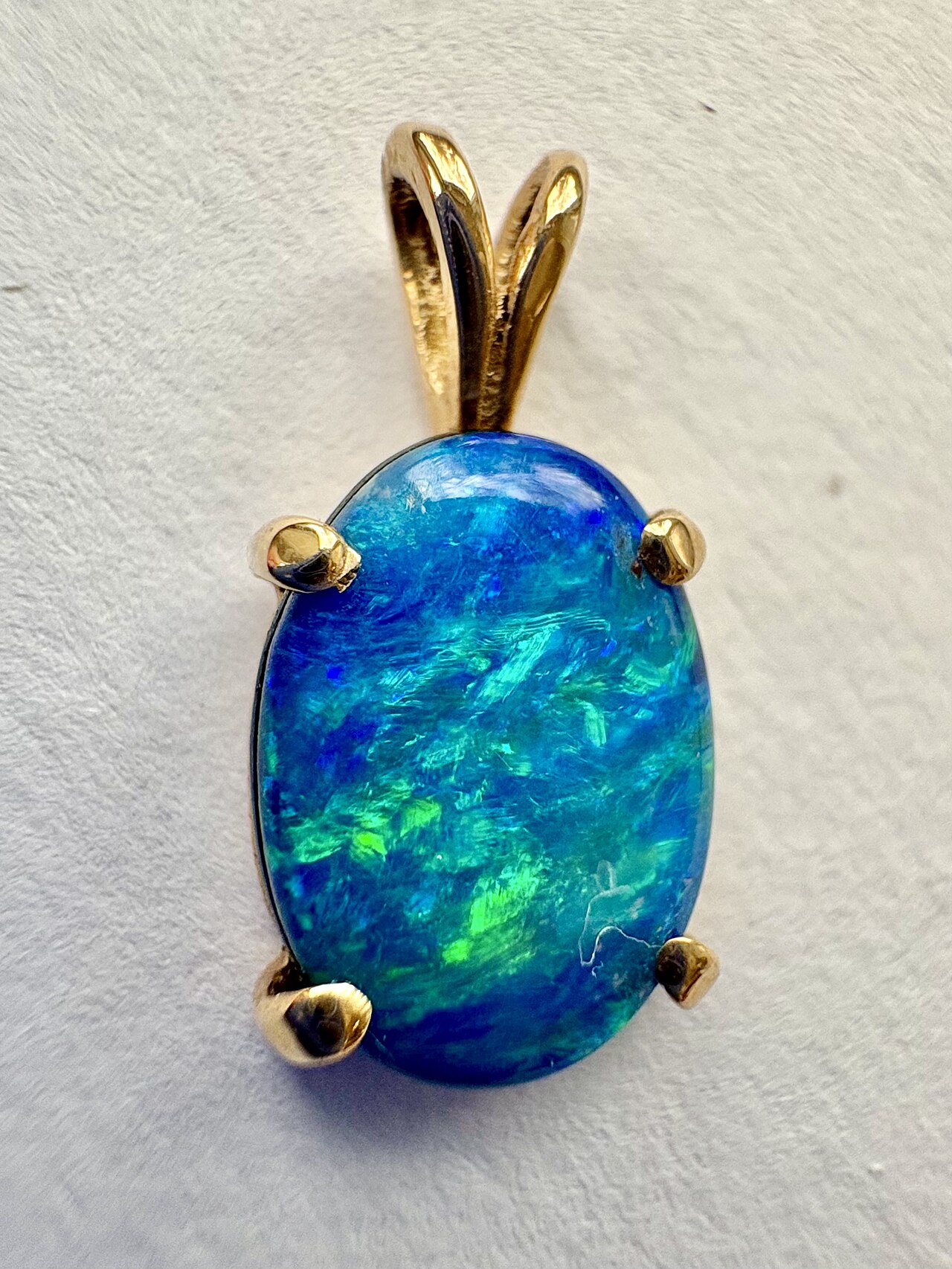
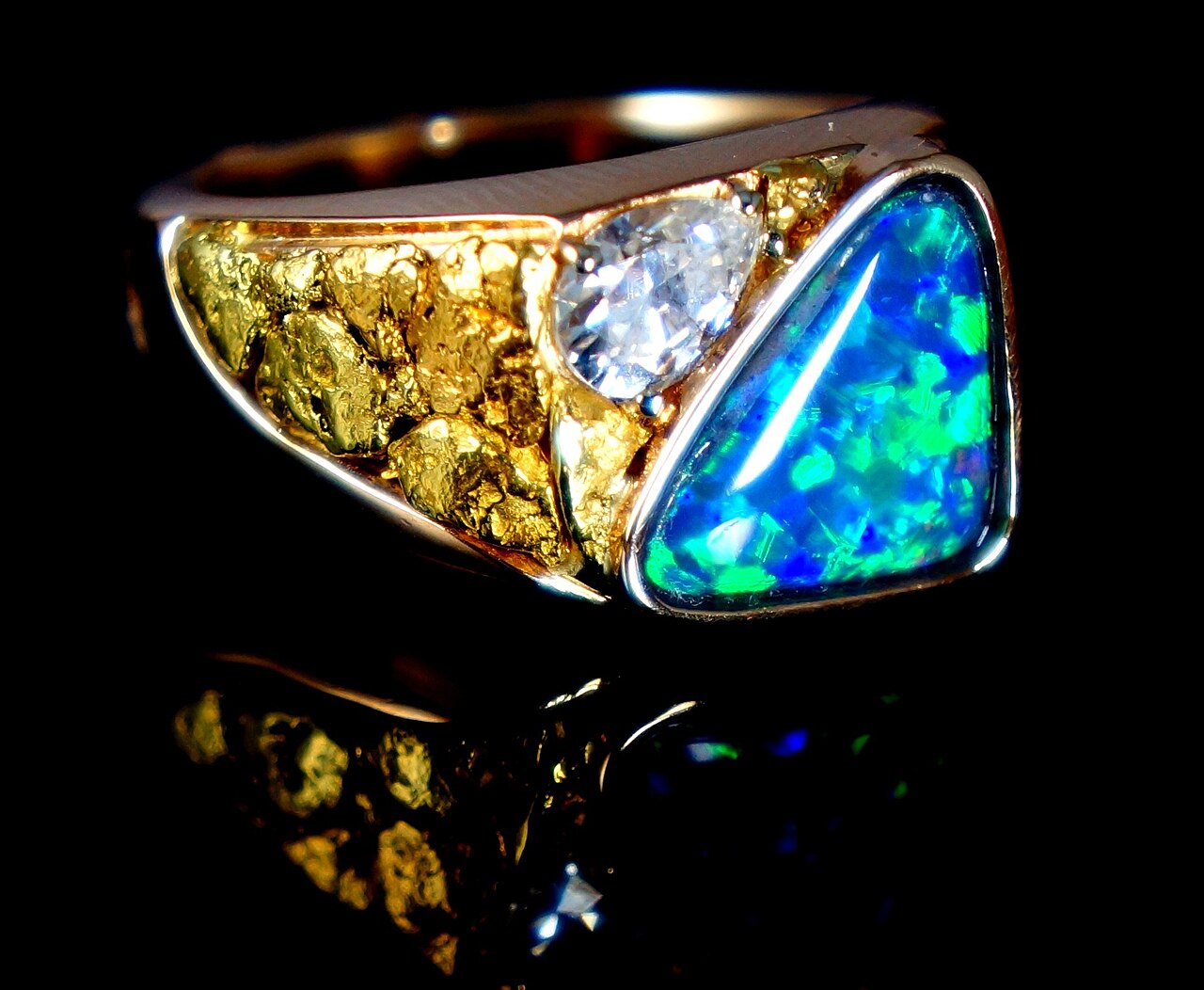
Opal's significance lies in its unique play-of-color, a pseudo-chromatic optical effect caused by diffraction from its internal structure of ordered silica spheres. This phenomenon, termed opalescence in gemology for common opal's hazy sheen, makes precious opal highly valued in jewelry. Most opal is cut as cabochons to maximize viewing angles. Thin opals may be combined into doublets (with a dark backing) or triplets (with a clear domed cap) to enhance appearance and durability. Opal's sensitivity to heat and scratching limits some jewelry applications. Historically rare and valuable in antiquity, opal was prized by European royalty; the only known source before Australian discoveries in the 19th century was Červenica in Slovakia. Australia is the primary source, with Coober Pedy, Mintabie, and Andamooka in South Australia being major producers. Ethiopian opal production is also significant, though data comparisons are complicated by differing measurement units.
Did You Know?
- Opal's water content may range from 3% to 21% by weight, but is usually between 6% and 10% (the broader range includes extreme cases and is not standard for precious opal).
- The name opal is believed to derive from the Sanskrit word 'upala', meaning 'jewel'.
- Black opal is considered the rarest variety, while white, gray, and green opals are the most common.
Discovery in Brazilian Earth
The Galaxy Opal's story begins deep in the Brazilian earth, at a site known as the Boi Morto Mine. In 1976, a rough piece of opal was recovered there, roughly the size of a grapefruit. Brazil is not typically the first country that comes to mind when one thinks of opal deposits, which makes this find all the more remarkable. The journey from a grapefruit-sized lump of rough stone in a Brazilian mine to a certified world record spans sixteen years, a testament to the patience and skill required to transform such a large and delicate material into something the world could marvel at.
The Carving and Craftsmanship
The transformation of the Galaxy Opal from rough to finished is a remarkable feat of lapidary artistry. This was no simple faceting job; the piece was large enough that the work required extraordinary precision and care. For a gemstone of this magnitude, every fraction of a millimeter of material removed represented a significant loss, making the sculptor's decisions about form and proportion all the more consequential. The choice to render it as a child's head rather than a conventional oval or cabochon cut gave the stone a distinctive character that set it apart from other large opals. Cooley's work turned a raw Brazilian mineral into something that felt almost figurative, a small sculpture rendered entirely in gemstone.
A Record That Defied the Scales
The process of verifying and documenting the stone presented practical challenges that underscore just how large it truly is. At the Gemological Institute of America, the finished stone's weight exceeded the capacity of every gem measuring scale available to them. No standard instrument in their laboratory could accommodate a piece of this magnitude, forcing the staff to resort to an improvised solution: a postal scale. This everyday piece of equipment, typically used for weighing letters and parcels, had to be called upon to approximate the stone's weight in carats. The stone's physical dimensions are equally striking at 14.0 by 10.2 by 4.1 centimetres, or roughly 5.5 by 4.0 by 1.6 inches. The fact that a postal scale was needed to weigh a world-record gemstone is a small but vivid detail that captures the sheer scale of the piece.
Legacy and a Private Resting Place
Today, the Galaxy Opal rests in a private collection, its glittering play-of-color visible only to those with access to that collection. This is in contrast to some other famous individual gemstones that are housed in public museums or institutional settings. Among the pantheon of notable opals, the Galaxy Opal holds a singular position as the largest polished specimen in the world, a title that distinguishes it from other celebrated stones such as the Andamooka Opal, the Flame Queen Opal, Halley's Comet Opal, and the Olympic Australis Opal. Each of these gems has its own story and its own claim to distinction, but none surpasses the Galaxy Opal in sheer size. The fact that it remains in private hands means that the general public encounters the Galaxy Opal primarily through photographs and written records rather than through direct observation, making its story one that is told through documentation and legacy rather than through a museum display case.
Common Misconceptions (Editorial)
Some people assume opal is a mineral, but it is actually classified as a mineraloid due to its amorphous structure. Another common misconception is that all opals display play-of-color; in fact, common opal varieties such as milk opal, Peruvian opal, and girasol opal do not show iridescence. Additionally, although black opal is often thought to be the most common variety, it is actually the rarest, while white, gray, and green opals are the most common.
Why It Matters (Editorial)
Opal endures as a subject of fascination because its unique play-of-color arises from ordered silica spheres interfering with light, a rare optical phenomenon that blends geology with physics. Its long history—reflected in its name tracing back to the Sanskrit word for "jewel"—and its wide variety of forms, from the rare black opal to the common but beautiful Peruvian blue opal, ensure it remains a gem of both scientific and cultural significance.
Gallery
More in Gemstones 1-22
Spotted an error? Know more?
This is a living reference — every entry is fact-audited, and reader corrections feed straight into our audit queue. Suggest an edit · See this site's audit record