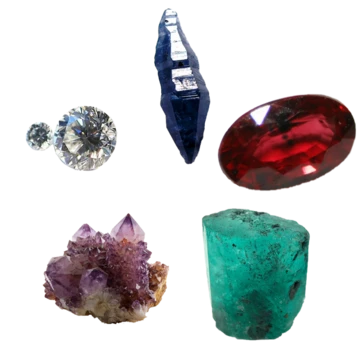
Turquoise
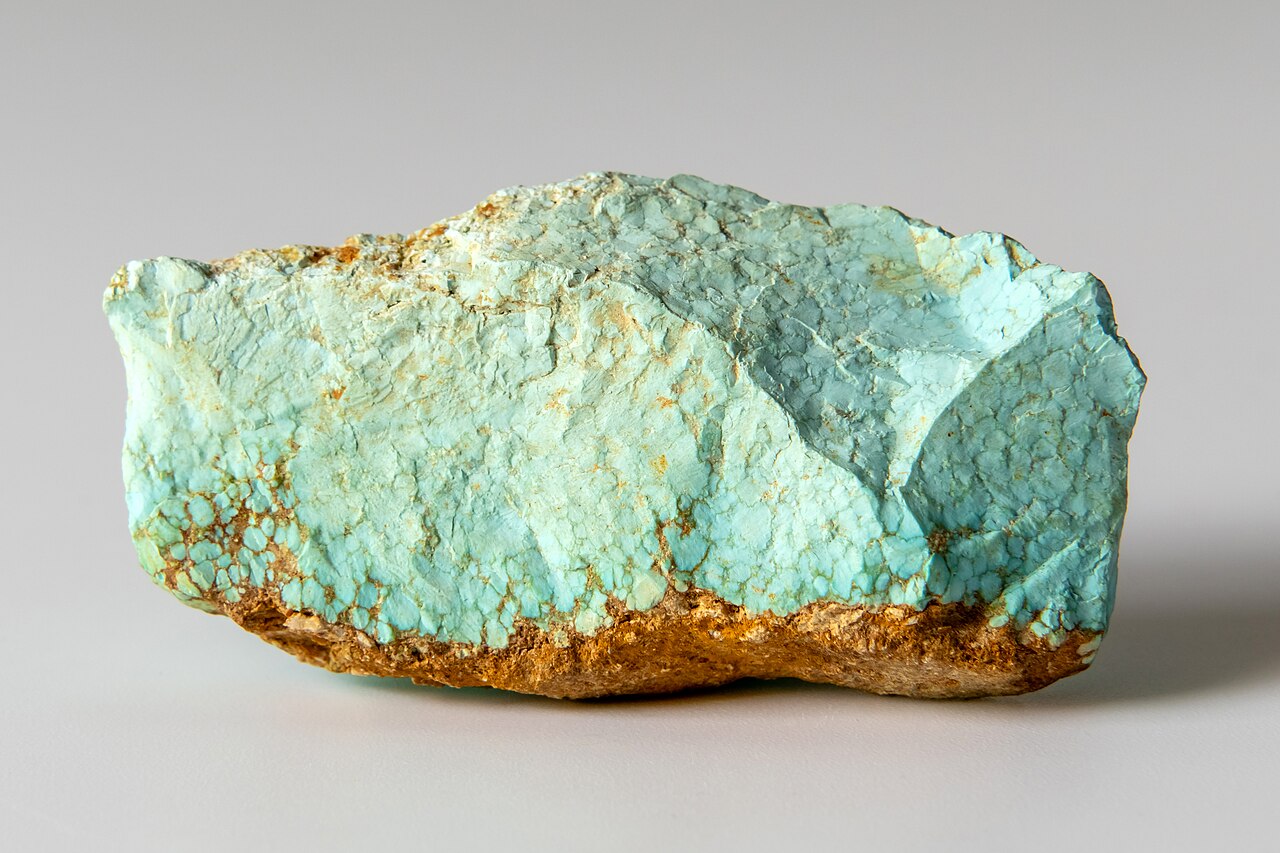
Ancient gemstone prized for its distinctive blue hue.

Tess Mattew · CC BY-SA 4.0
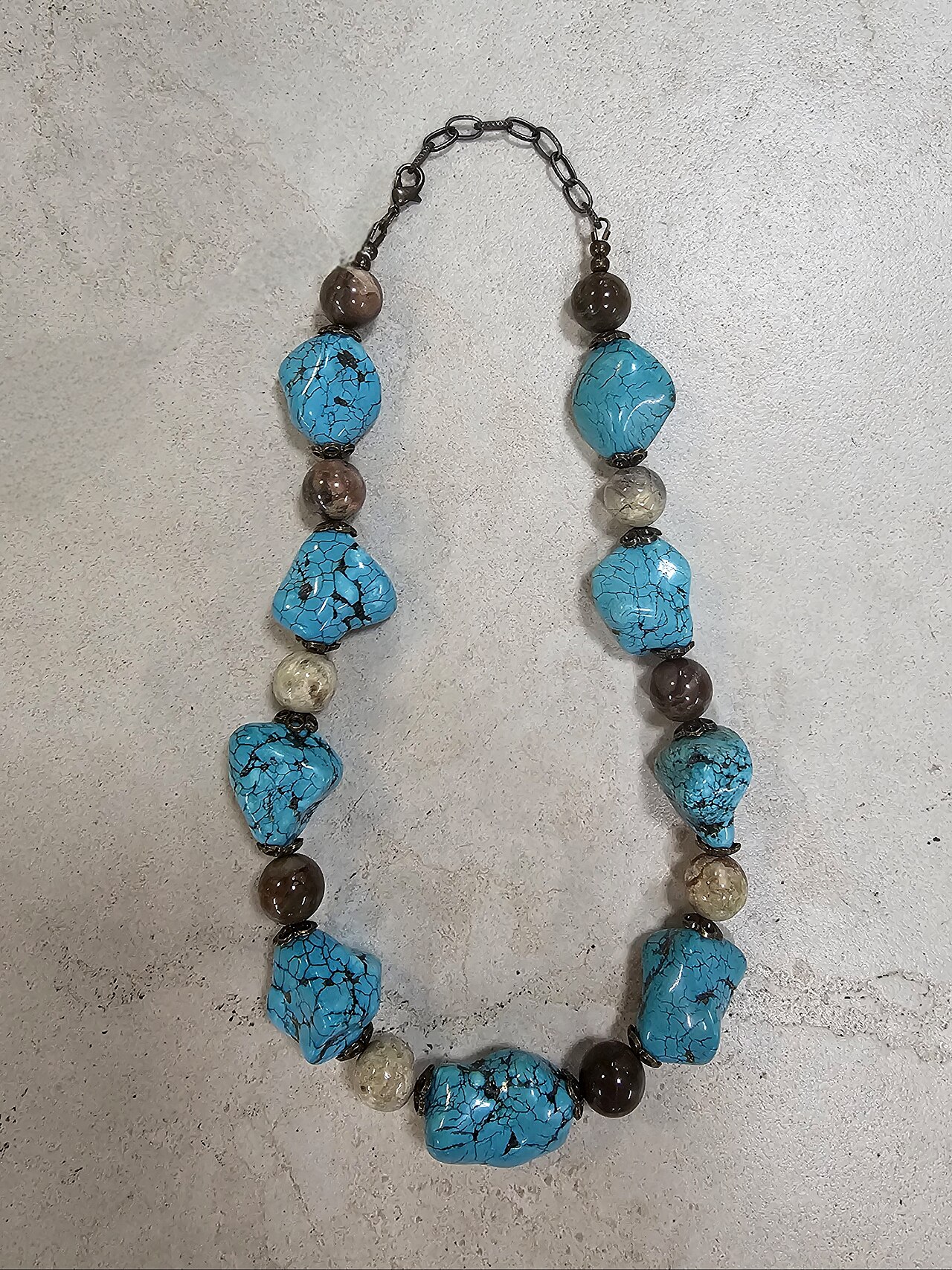
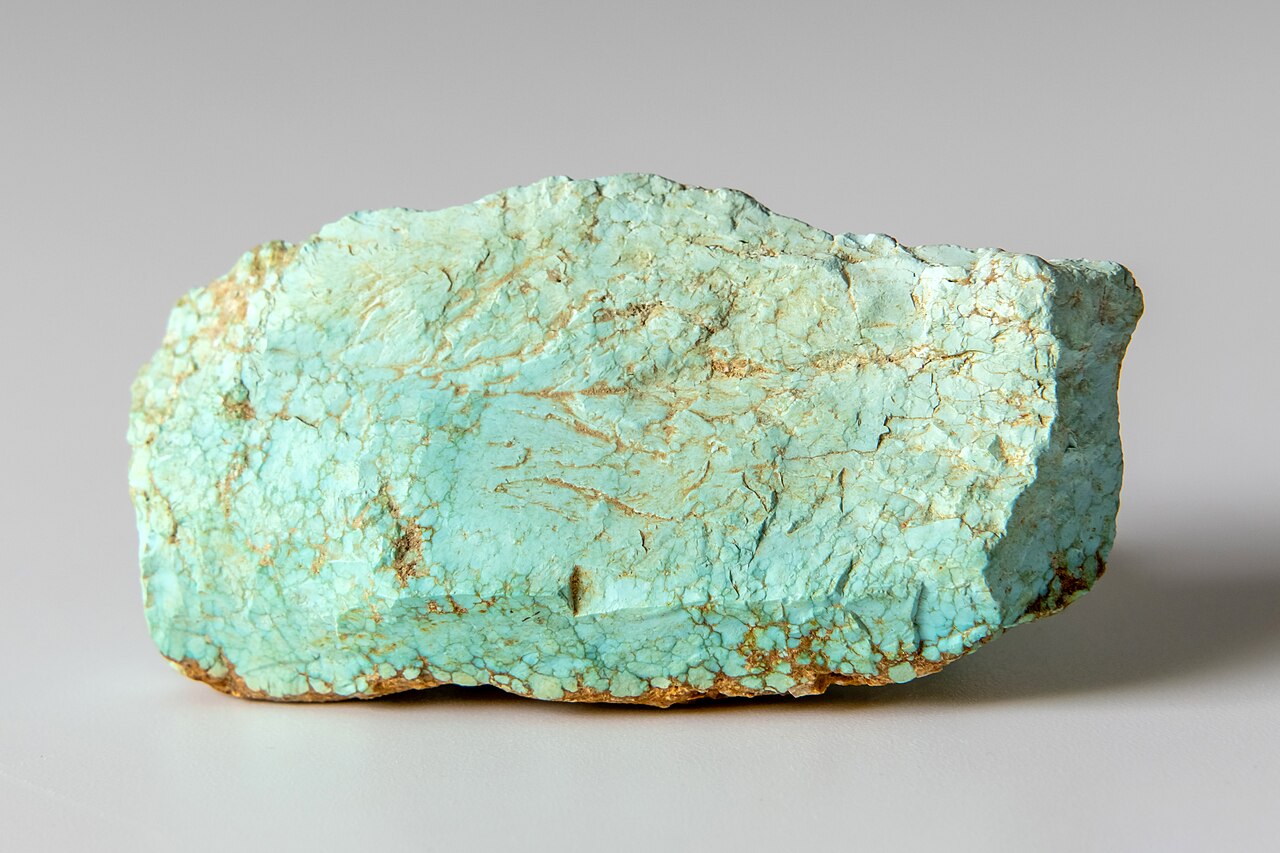
Turquoise is an opaque, blue-to-green mineral that is a hydrous phosphate of copper and aluminium, with the chemical formula CuAl6(PO4)4(OH)8·4H2O. It is rare and valuable in finer grades and has been prized as a gemstone for millennia due to its hue. The mineral has been mined since ancient times in Iran, the Sinai Peninsula, and the Americas, and its name derives from the Old French for 'Turkish,' reflecting its route to Europe through the Ottoman Empire.
- chemical_formula
- CuAl6(PO4)4(OH)8·4H2O
- crystal_system
- Triclinic
- mohs_hardness
- Just under 6
- color
- White to powder blue to sky blue to blue-green to yellowish green
- refractive_index
- 1.61 to 1.65
- streak
- White to greenish to blue
- luster
- Waxy to subvitreous
Lore & Background
Turquoise was mined by pre-Columbian Native Americans in deposits in New Mexico and likely in California, and was used by the Ancient Egyptians, though not very commonly.
Reader's Guide
Turquoise has been valued as a gemstone for millennia, with its sky-blue Persian variety from near Nishapur, Iran, serving as the quality standard. The mineral forms as a secondary supergene deposit when meteoric water percolates through copper porphyries, oxidizing copper sulfides and reacting with aluminum and potassium minerals. Turquoise deposits are widespread in North America, Iran, and the Sinai Peninsula, but many historic sites have been depleted. Like most opaque gems, turquoise has been devalued by treatments, imitations, and synthetics. Its properties are highly variable, with color attributed to idiochromatic copper (blue) or iron impurities (green). Turquoise is nearly always cryptocrystalline and massive, rarely forming crystals, and takes a good polish despite its moderate hardness.
Did You Know?
- The word 'turquoise' dates to the 16th century and is derived from Old French 'turquois' meaning 'Turkish,' though the mineral came from Persia and is not found in Turkey.
- Pliny the Elder referred to turquoise as 'callais,' and the Aztecs knew it as 'chalchihuitl.'
- Turquoise forms a complete solid solution series with chalcosiderite, in which ferric iron replaces aluminium.
- Odontolite is fossil bone or ivory historically thought to have been altered by turquoise or similar phosphate minerals.
Etymology and the Misnomer
The word turquoise traces back to the 16th century, rooted in the Old French turquois, which simply meant Turkish. This naming is a historical error: the mineral reached Europe through the Ottoman Empire, yet it was originally extracted from mines in the Khorasan province of what is now Iran (Persia). The stone has never been found in Turkey, rendering the name a persistent misnomer. Long before the French term took hold, Pliny the Elder referred to the mineral as callais, borrowed from the Ancient Greek word κάλαϊς. The Aztec civilization likewise had their own name for it: chalchihuitl. In professional mineralogy, the scientific designations kalaite and azure spar were in use until the mid-19th century, offering yet another layer to the stone's nomenclature, though these terms gradually faded from common usage and never became widespread.
The Mineral and Its Chemistry
Turquoise is an opaque mineral whose color spans from blue to green, producing the distinctive cyan hue that gave the color its name. Chemically, it is a hydrous phosphate composed of both copper and aluminium, described by the formula CuAl6(PO4)4(OH)8·4H2O. This particular combination of elements is what generates the stone's remarkable and unique coloration, making it rare and highly valued in its finer grades. For thousands of years, turquoise has been prized not merely as a gemstone but as an ornamental material, its distinctive hue setting it apart from other blue and green stones. The mineral's opacity and the specific interplay of copper and aluminium within its crystal structure lend it a quality that is difficult to replicate, a significant reason it has maintained its status as a treasured material across so many different cultures and millennia.
A Deep and Diverse Mining History
Turquoise carries a remarkably deep and geographically diverse history of human use. Pre-Columbian Native Americans extracted the stone from deposits in New Mexico, particularly at Los Cerrillos, and likely from sites in California as well. The Ancient Egyptians also worked with turquoise, though it was not a commonly used material in their culture. European interest in turquoise mining was relatively brief, emerging in the late 1800s.
Color Variations and Cultural Presence
Beyond the base turquoise hue, the color family encompasses several distinct variations. Celeste represents a sky-blue shade of turquoise, while light turquoise is simply a paler tone of the base color. The digital and web color systems include medium turquoise and dark turquoise as defined web colors, while bright turquoise represents a more saturated version of the hue. In the X11 color system, a specific turquoise value is defined and displayed. The color and stone carry strong cultural associations with the domes and interiors of large mosques across Iran, Central Asia, and Russia, where the turquoise aesthetic is deeply embedded in architectural tradition. This range of variations allows the color to express different moods and intensities while remaining firmly within the cyan family that the original mineral inspired.
Common Misconceptions (Editorial)
1. Some believe turquoise is found in or named after Turkey, but the facts confirm it is not found there naturally; the name derives from Old French for “Turkish,” reflecting its trade route through the Ottoman Empire, while the mineral itself originated in Persia. 2. A common misconception is that turquoise is always bright sky-blue; in reality, its color ranges from white to powder blue to sky blue to blue-green to yellowish green, as shown in the facts.
Why It Matters (Editorial)
Turquoise endures as a gemstone because its unique, vivid hues have been valued across civilizations for millennia—from ancient Egyptians and pre-Columbian Native Americans to modern collectors. Its rarity in fine grades and cultural significance as a symbol of status and protection continue to make it a lasting treasure in jewelry and art.
Gallery


More in Gemstones 1-22
Spotted an error? Know more?
This is a living reference — every entry is fact-audited, and reader corrections feed straight into our audit queue. Suggest an edit · See this site's audit record