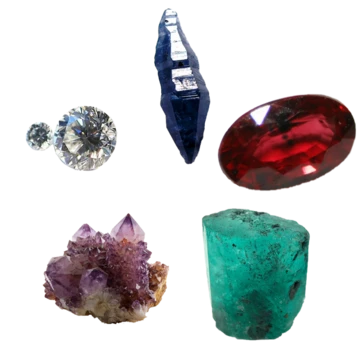
Moonstone
Feldspar gemstone known for its pearly, opalescent schiller.

Moonstone is a sodium potassium aluminium silicate ((Na,K)AlSi3O8) of the feldspar group that displays a pearly and opalescent schiller. An alternative name for moonstone is hecatolite (from goddess Hecate). The name moonstone derives from the stone's characteristic visual effect, called adularescence (or schiller), which produces a milky, bluish interior light.
- classification
- Feldspar mineral
- chemical_formula
- (Na,K)AlSi3O8
- alternative_name
- Hecatolite
- visual_effect
- Adularescence (schiller)
- common_varieties
- Blue moonstone, labradorite moonstone, orthoclase moonstone, rainbow moonstone, adularia
- major_deposits
- Sri Lanka, Myanmar, India, Madagascar, United States
Lore & Background
Moonstone has been used in jewellery for millennia, including ancient civilizations. The Romans admired moonstone, as they believed it was derived from solidified rays of the Moon. Both the Romans and Greeks associated moonstone with their lunar deities. In more recent history, moonstone became popular during the Art Nouveau period; French goldsmith René Lalique and many others created a large quantity of jewellery using this stone. The most common moonstone is of the orthoclase feldspar mineral adularia, named for an early mining site near Mt. Adular in Switzerland, now the town of St. Gotthard. Deposits of moonstone occur in Armenia (mainly from Lake Sevan), Australia, the Austrian Alps, Mexico, Madagascar, Myanmar, Norway, Poland, India, Sri Lanka, and the United States. Historically, the most valuable, transparent moonstones with strong blue sheen came from Myanmar. Today, most commercial moonstones come from Sri Lanka. Gemologists classify moonstone into several distinct varieties. Blue moonstone represents the finest variety of labradorite moonstone, with high transparency and strong blue adularescence. Orthoclase moonstone belongs to the monoclinic crystal system and displays a mystical white glow. Gem enthusiasts often refer to adularescent labradorite with a multi-colored glow as 'rainbow moonstone.'
Reader's Guide
Moonstone's significance lies in its unique optical phenomenon—adularescence—caused by light diffraction through alternating layers of orthoclase and albite. This effect, varying from white to blue, has made it a prized gemstone across cultures for millennia. The Romans and Greeks linked it to lunar deities, and it saw a resurgence during the Art Nouveau period, notably used by French goldsmith René Lalique. In Thailand, it is known as Mukdahan, named after a province and a folklore gemstone. Geologically, moonstone forms from exsolution layers of alkali feldspars, with major deposits in Sri Lanka, Myanmar, and India. Its varieties—including blue moonstone, rainbow moonstone, and adularia—offer a range of colors and sheens, making it a versatile gem for jewellery. The stone's chatoyancy and rare asterism add to its allure, while its historical and cultural associations continue to sustain its popularity.
Did You Know?
- Moonstone is also known as hecatolite, named after the goddess Hecate.
- The Romans believed moonstone was derived from solidified rays of the Moon.
- In Thailand, moonstone is called Mukdahan, the same name as a northeastern province.
Common Misconceptions (Editorial)
Some people mistakenly believe that moonstone is a single, uniform gemstone, but in fact it occurs in several distinct varieties, including blue moonstone, labradorite moonstone, orthoclase moonstone, rainbow moonstone, and adularia. Another common misconception is that all moonstone comes from a single location; however, deposits are found in many countries, including Sri Lanka, Myanmar, India, Madagascar, Australia, and the United States. Additionally, some may think "rainbow moonstone" is a distinct mineral, but it is actually a variety of adularescent labradorite.
Why It Matters (Editorial)
Moonstone endures because its ethereal, moon-like glow taps into a universal human fascination with light and celestial beauty, bridging ancient mythology and modern jewelry design. Its long history—from Roman and Greek lunar worship to Art Nouveau masterpieces—shows how a single stone can carry cultural meaning across millennia, making it a lasting symbol of mystery and elegance.
More in Gemstones 1-22
Spotted an error? Know more?
This is a living reference — every entry is fact-audited, and reader corrections feed straight into our audit queue. Suggest an edit · See this site's audit record