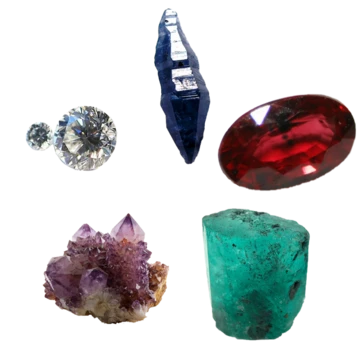
Quartz
A hard, abundant mineral used in jewelry and technology.

Quartz is a hard mineral composed of silica (silicon dioxide), with atoms linked in a continuous framework of SiO4 tetrahedra. It is the second most common mineral in Earth's lithosphere, comprising about 12% by mass, and has been used since antiquity in jewelry and hardstone carvings, especially in Europe and Asia.
- chemical_formula
- SiO2
- classification
- Framework silicate mineral and oxide mineral
- hardness
- 7 on Mohs scale
- crystal_system
- Trigonal (α-quartz) and hexagonal (β-quartz)
- common_varieties
- Rock crystal, amethyst, citrine, rose quartz, smoky quartz, milky quartz
Lore & Background
Quartz has been known since antiquity; the Ancient Greeks called it κρύσταλλος (krustallos), meaning 'crystal', believing it to be supercooled ice. Roman naturalist Pliny the Elder also thought quartz was permanently frozen ice, a belief that persisted until the 17th century. In the 17th century, Nicolas Steno's study of quartz established the law of constancy of interfacial angles, paving the way for modern crystallography.
Reader's Guide
Quartz is significant as the defining mineral for hardness 7 on the Mohs scale and as a key component of many rocks, including granite, sandstone, and quartzite. Quartz varieties, from transparent rock crystal to colored amethyst and citrine, have been prized as gemstones for millennia.
Did You Know?
- Quartz is the second most common mineral in Earth's lithosphere, comprising about 12% by mass.
Common Misconceptions (Editorial)
Some people think quartz is rare or only found as clear crystals, but it is actually the second most common mineral in Earth’s lithosphere, comprising about 12% by mass. Others believe the ancient idea that quartz is permanently frozen ice, but this is a misconception—quartz is a hard mineral composed of silica (silicon dioxide), not ice.
Why It Matters (Editorial)
Quartz endures as a subject of fascination not only for its beauty in jewelry and carvings but also for its pivotal role in the history of science. The 17th-century studies of quartz by Nicolas Steno established the law of constancy of interfacial angles, laying the groundwork for modern crystallography, which remains fundamental to geology, chemistry, and materials science.
More in Gemstones 1-22
Spotted an error? Know more?
This is a living reference — every entry is fact-audited, and reader corrections feed straight into our audit queue. Suggest an edit · See this site's audit record